ReMeP-IRI§ Hackathon 2025/26: Winners of the Second “Law as Code” Hackathon Announced
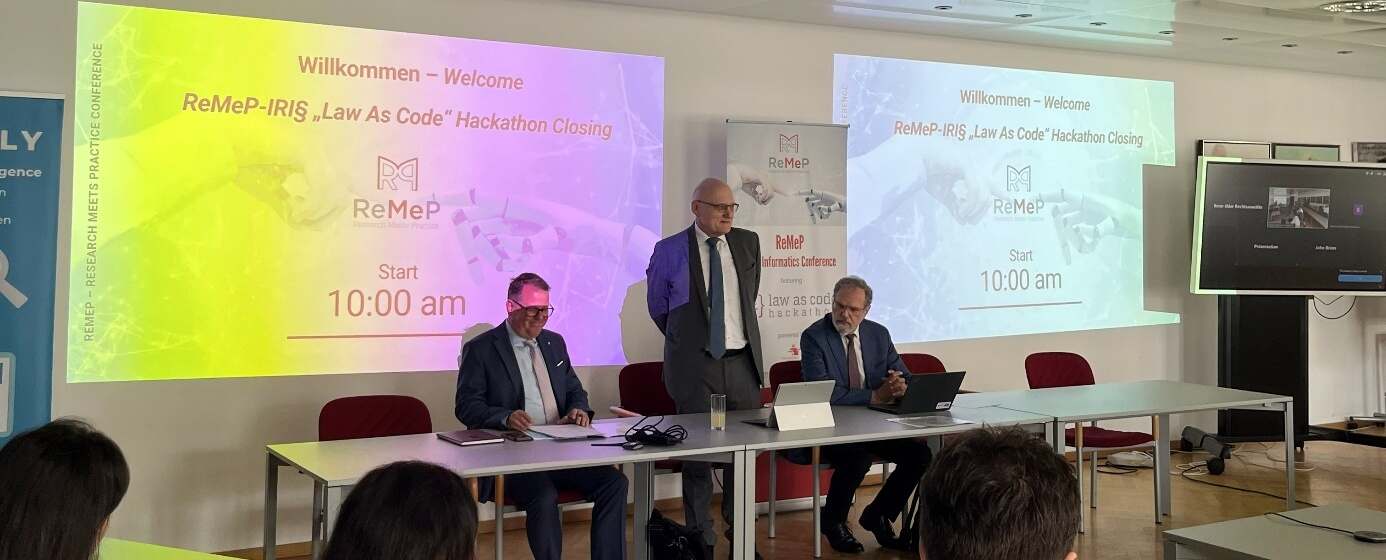
On Monday, 27 July 2026, the second ReMeP-IRI§ “Law as Code” Hackathon 2025/26 formally concluded with a ceremonial event at the Austrian Federal Ministry of Justice in Vienna. Nine months after its launch at the ReMeP Conference in October 2025, the three finalist teams presented their completed prototypes at Palais Trautson to an audience drawn from the judiciary, academic, as well as the legal technology community.
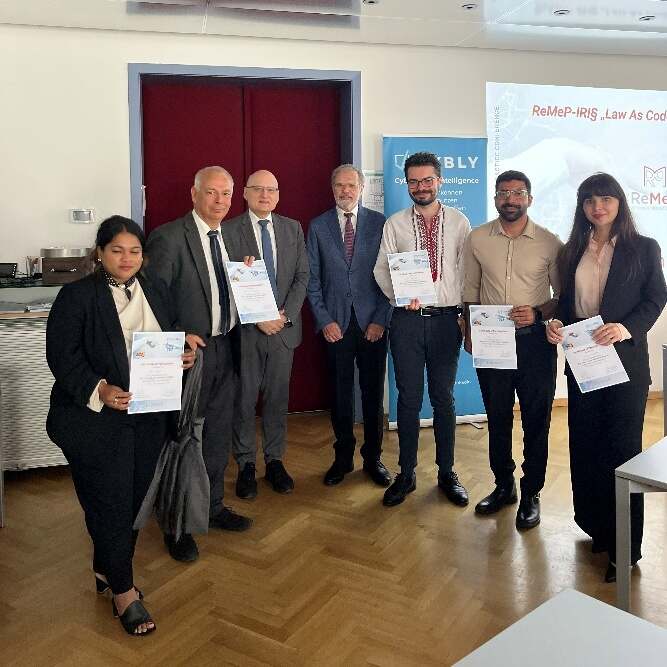
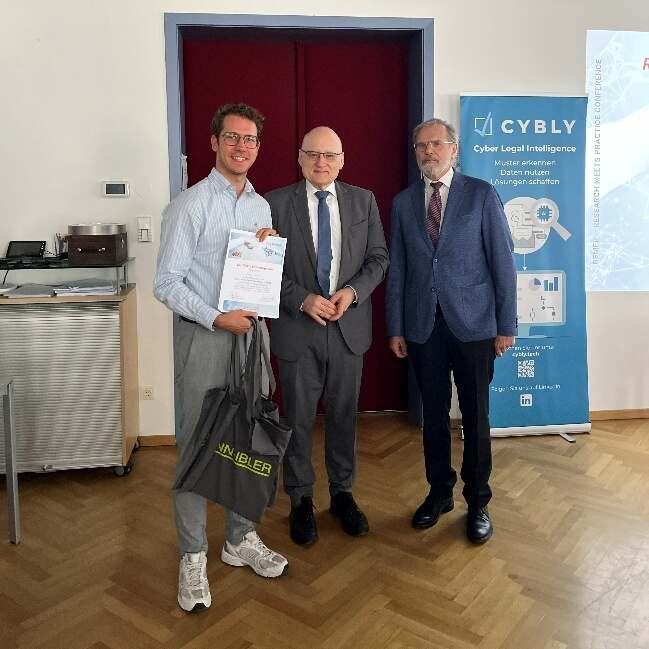
“Law as Code” Hackathon 2025/26 Final Ceremony: A Fitting Forum
Guests were welcomed by Senior Public Prosecutor Dr Thomas Gottwald of the Austrian Federal Ministry of Justice, Dr Stefan Eder of ReMeP and Professor Dr Erich Schweighofer of IRI§ — a joining of forces between judicial practice, the research network, and the legal informatics community that had shaped the hackathon from the outset. Following the opening remarks, #ICAIL2027Vienna was announced as the next major date for the international legal AI community before the spotlight shifted to the teams: From 10.30 a.m. onwards, they took the stage to showcase their projects, building towards the award ceremony.
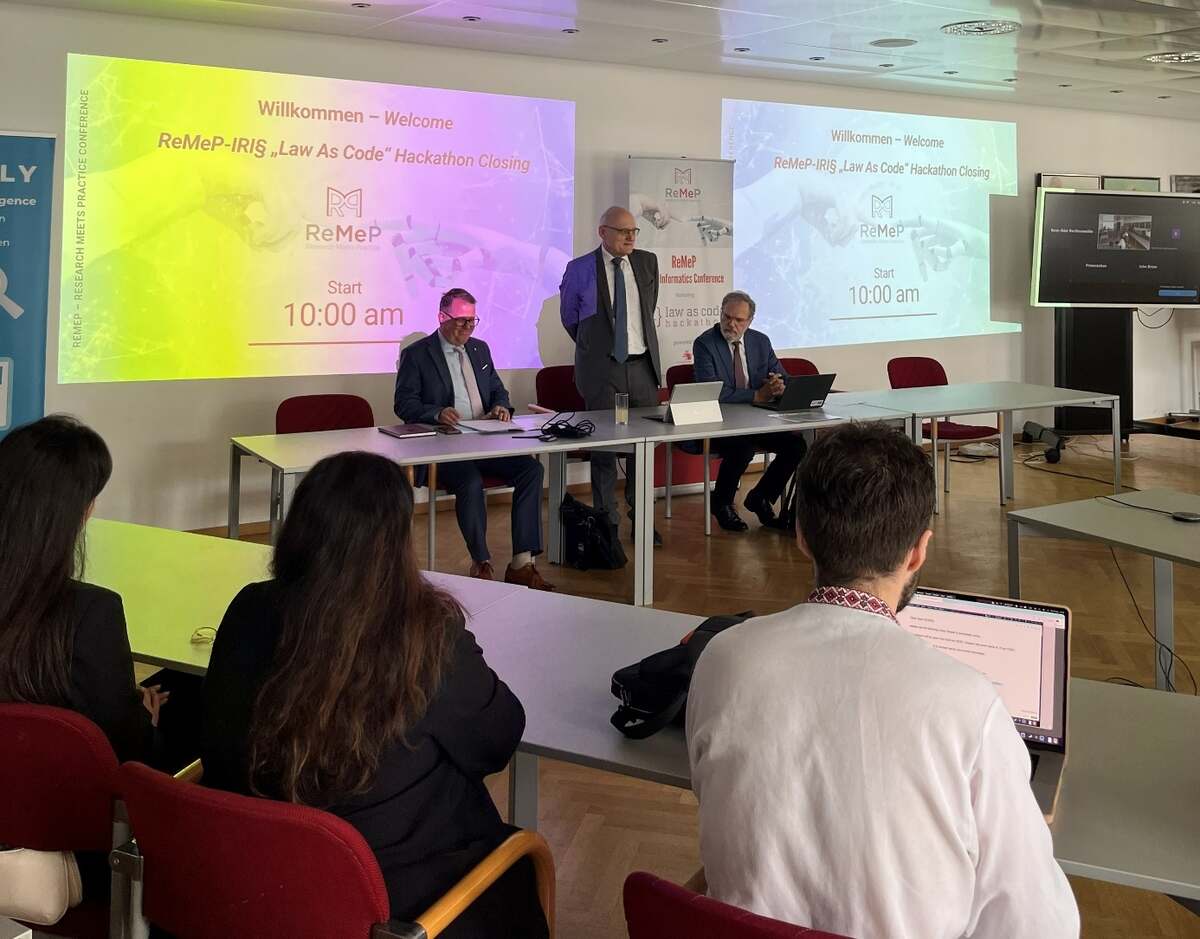
Since its launch, the Law as Code Hackathon has pursued a clear objective: Interdisciplinary teams comprising lawyers, computer scientists, and students develop executable prototypes designed to address practical challenges in the judiciary, public administration, and private-sector administrative processes — from automating legal review procedures to improving public access to the law. Following an optional interim presentation at IRI§26 in Salzburg in February 2026, the three finalist teams advanced to the final round with solutions that were both highly diverse and strongly practice oriented.
“Law as Code” Hackathon 2025/26: The Three Final Projects
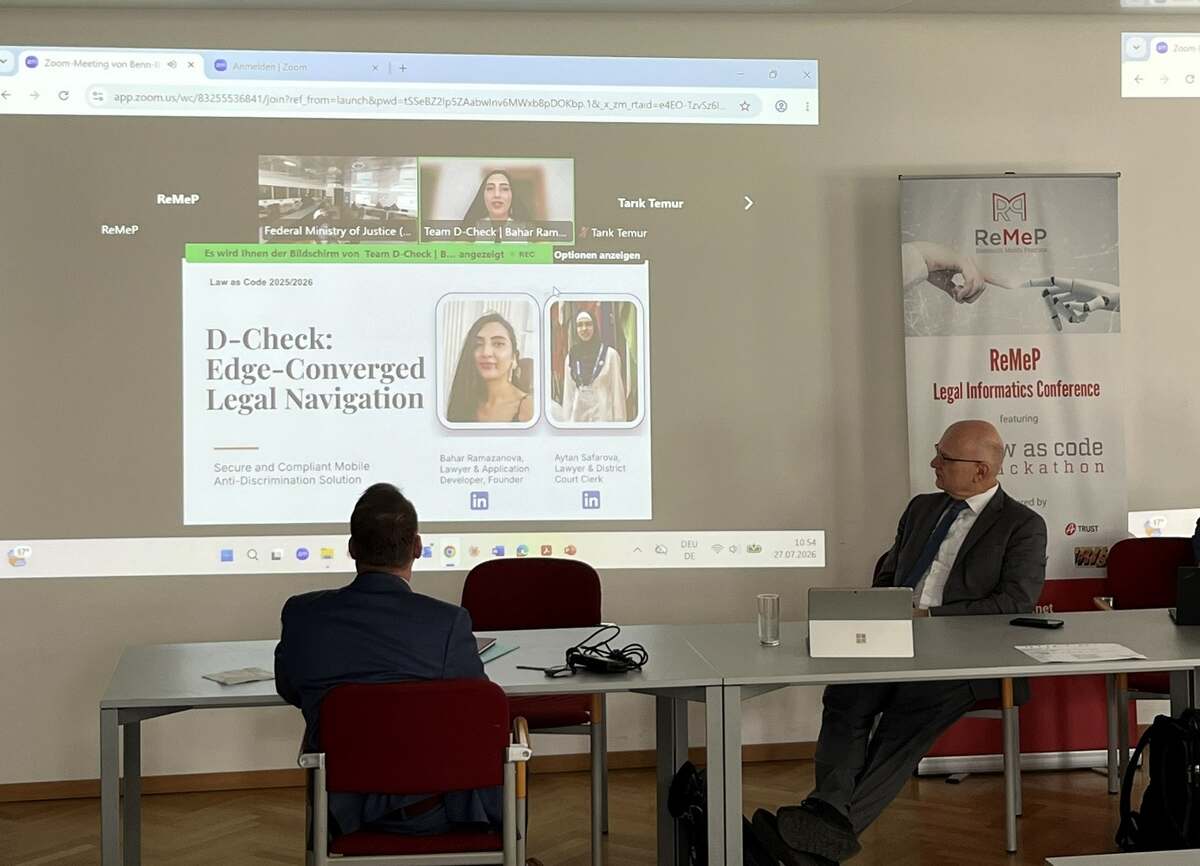
D-Check – Discrimination Protection That Stays on Your Own Phone
The team led by Azerbaijani lawyers Bahar Ramazanova and Aytan Safarova developed D-Check, a mobile application designed to support individuals affected by discrimination in understanding their rights under EU anti-discrimination law, by systematically collecting evidence and preparing a formal complaint. Its technical architecture is what sets D-Check apart: Sensitive personal information is processed, wherever possible, directly on the user’s device and entirely without any internet connection. Local recognition logic classifies experiences in real time by relevant grounds of discrimination — including age, disability, gender, and nationality — and directs users to the applicable EU directives. Only with the user’s explicit consent is a request encrypted and temporarily forwarded to an AI model, with no data stored. In testing, the local classification achieved an accuracy rate of 94.2 per cent. The application was illustrated by a case example from the pitch: A foreign employee in Vienna fears that a cloud-based app could reveal her residence status when documenting a discriminatory termination by her employer. D-Check allowed her to document the incident securely on her own device, ensuring her data remained under her control.
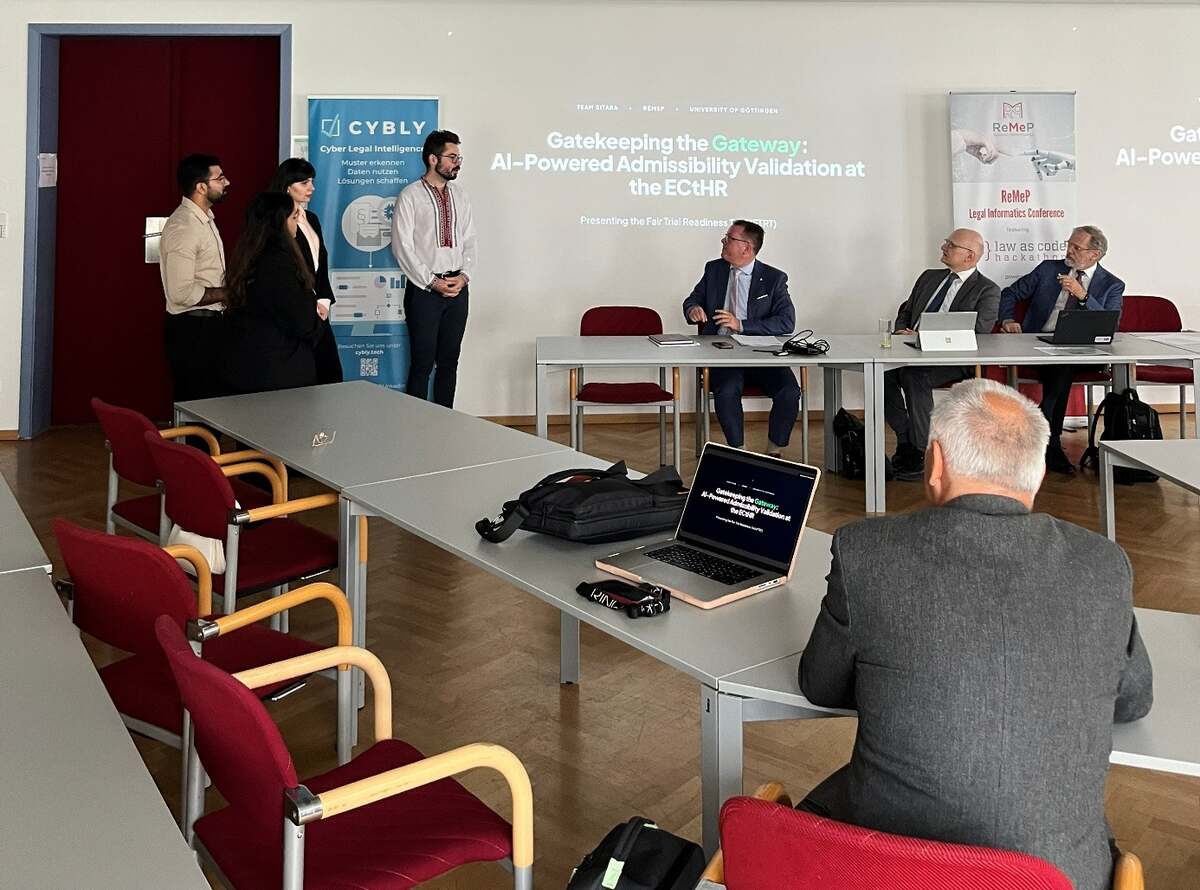
Team SITARA (University of Göttingen) – The Gatekeeper for Strasbourg
A team from the German University of Göttingen — Andrii Prylutskyi, Tarik Temur, Salome Rtveladze, Jyoti Goyal, Irakli Mikadze, and Ahsan Ali, supervised by Professor Zsolt György Balogh — addressed a structural challenge facing the European Court of Human Rights (ECtHR): Between 2021 and 2025, more than 157,000 applications were rejected, representing a cumulative inadmissibility rate of 85 per cent. In 2025 alone, nearly 27,500 applications were dismissed by single judges without any reasons being provided. The issue frequently lies not in the substantive merits of the case, but in the stringent formal requirements of Rule 47 of the Rules of Court: A 13-page form comprising 74 mandatory fields, where even a single error — such as a missing date or an insufficiently precise formulation of the relief sought — may result in non-registration. Moreover, an incomplete submission does not suspend the strict four-month time limit. The team’s proposed solution is the Fair Trial Readiness Tool (FTRT), an AI-supported preliminary review mechanism designed to assist NGO caseworkers in examining ECtHR applications prior to submission for these specific formal deficiencies. Rather than relying on a general-purpose language model, the mechanism applies 74 field-specific, legally curated validation rules that precisely mirror the structure of the application form, functioning in a manner comparable to an experienced legal assistant reviewing each field individually. A human-in-the-loop process is intentionally embedded – lawyers are required to confirm each value extracted by the AI before the report is generated, thereby reducing the risk of uncritical reliance on automated outputs. The tool is not intended to replace legal advice or to predict admissibility; rather, it addresses the procedural gap between complex human rights violations and stringent formal requirements.
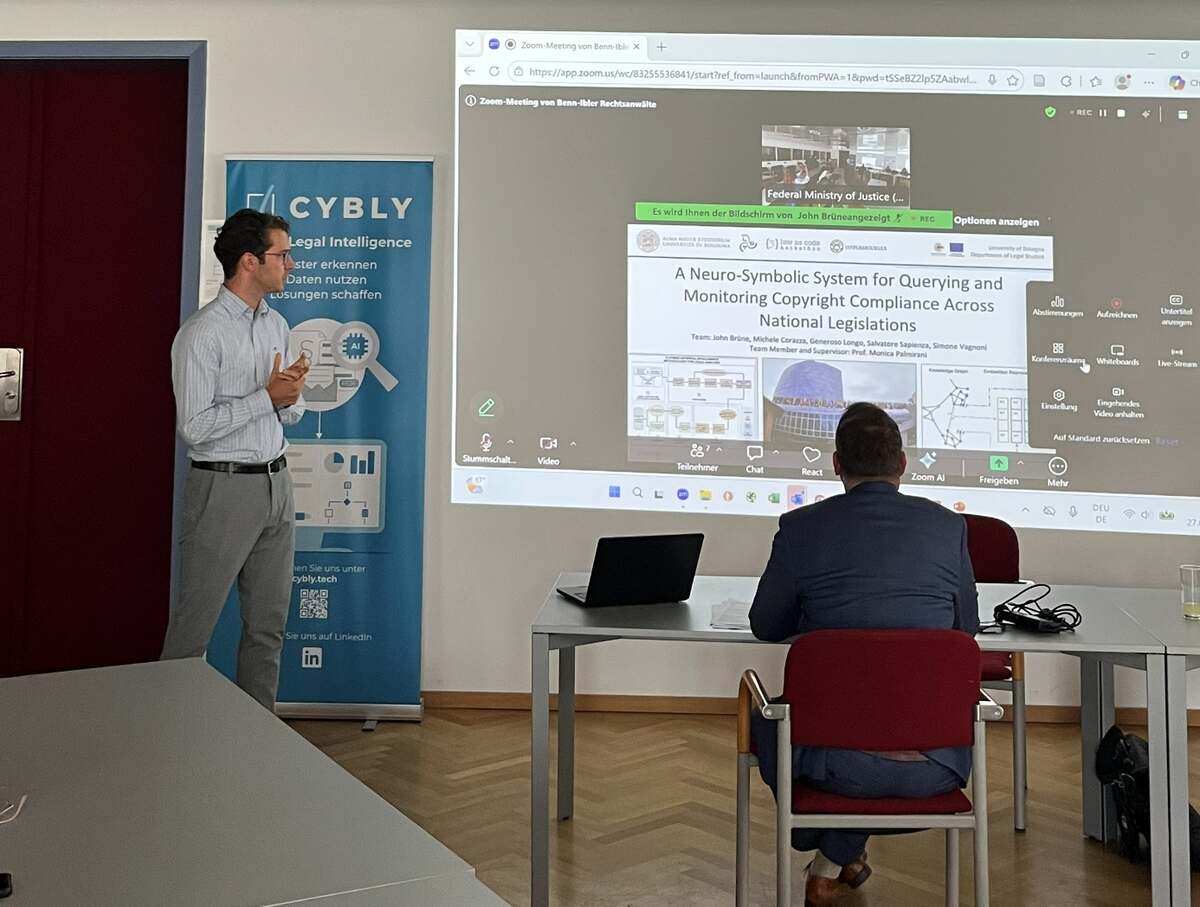
Team Bologna – Making Copyright Law Comparable Worldwide
The team from the University of Bologna — John Brüne, Michele Corazza, Generoso Longo, Salvatore Sapienza, and Simone Vagnoni, under the leadership of Professor Monica Palmirani — addressed a task that has traditionally depended to a significant extent on manual expert analysis: determining whether national copyright legislation complies with international agreements, such as the Berne Convention. To this end, the team developed a neuro-symbolic system that represents nine legal orders — including those of Germany, France, Italy, Switzerland, the United Kingdom, the United States, Canada and New Zealand, as well as EU Directive 2006/116/EC — as machine-readable Akoma Ntoso XML documents and linked them within a knowledge graph. For Italy, the system also integrates 68 historical versions of the Copyright Act from 1941 to 2025, enabling users to trace the evolution of the law over time. Users may submit queries in any language — for example, “Quando scade il diritto d’autore in Francia?” — whereupon a language model structures the query, the knowledge graph identifies the applicable legal basis, and the response is accompanied by a direct reference to the relevant source text, including the highlighted passage relied upon. In a second mode, the system conducts a purely symbolic assessment — without the language model participating in the substantive determination — as to whether the national term of protection satisfies the requirement of 50 years post mortem auctoris laid down in Article 7 of the Berne Convention. In all nine legal systems examined, the system produced the legally correct result; New Zealand was found to satisfy the requirement precisely to the day. The full codebase is made available as open source on GitHub.
“Law as Code” Hackathon 2025/26: The Award Ceremony
After a series of strong presentations, the jury had a tough choice to make and ultimately agreed on the following ranking:
- 1st place: Team Bologna, recognised for its neuro-symbolic system for assessing compliance with international copyright treaties
- 2nd place, ex aequo: Team SITARA from the University of Göttingen, recognised for the Fair Trial Readiness Tool, and Team D-Check, recognised for its anti-discrimination application
Each of the three projects demonstrates, in a distinct manner, the potential of technological solutions to enhance access to justice — whether by strengthening data sovereignty for affected individuals, mitigating procedural formal errors or increasing transparency in the implementation of international legal obligations. What unites the teams is a shared commitment to advancing technological innovation not at the expense of legal rigour, but in close alignment with it.
“Law as Code” Hackathon: Outlook
By announcing ICAIL 2027 in Vienna, ReMeP has identified a further important milestone in the continuing development of the relationship between law and technology, and in the sustained exchange between academic research and professional practice. We extend our sincere congratulations to all three teams on their impressive achievements and would like to express our gratitude to the Austrian Federal Ministry of Justice for its hospitality, as well as to all mentors, members of the jury, and supporters whose contributions were instrumental in making the second ReMeP-IRI§ Law as Code Hackathon possible.
